Introduction
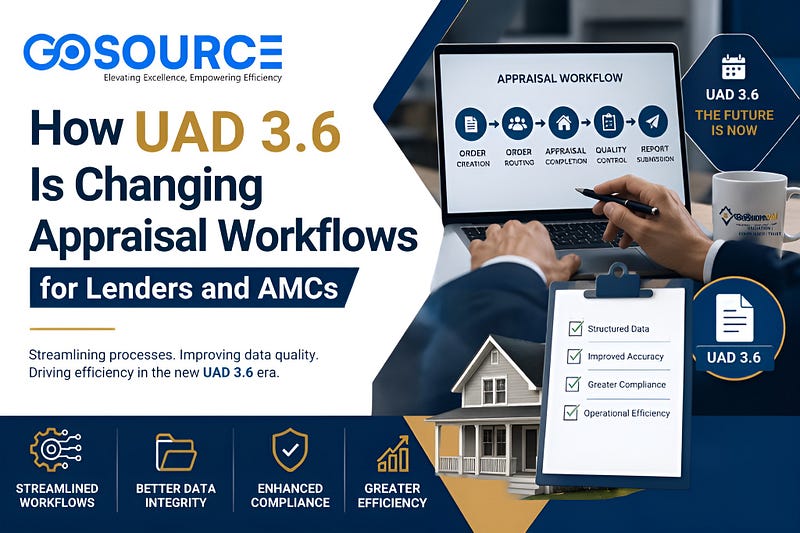
When the Government-Sponsored Enterprises introduced the Uniform Appraisal Dataset 3.6 UAD 3.6, they did more than update a reporting format. They fundamentally altered the mechanics of how appraisal orders are defined, managed, submitted, and reviewed across the entire lending ecosystem.
For lenders and appraisal management companies like AMCs, the implications are far-reaching. UAD 3.6 touches every stage of the appraisal workflow from the moment an order is placed to the final delivery of a compliant report. Organizations that approach this as a minor system update will be caught off guard. Those who treat it as an operational transformation will find new efficiencies and competitive advantages on the other side.
This article explores the specific workflow changes that UAD 3.6 demands, how to restructure your processes accordingly, and where to access expert guidance throughout the transition. For the complete framework breakdown, make sure to visit Gosourceval’s in-depth UAD 3.6 guide the professional resources built for industry leaders navigating this shift.
Understanding the Core Workflow Shift
From Forms to Datasets
In the pre-UAD 3.6 world, an appraisal order was a product selection. A lender or AMC identified the appropriate form 1004, 1073, 1025, assigned it to an appraiser, and received a completed document in return. The process was form-centric, and most technology platforms were built to optimize that model.
UAD 3.6 breaks this model entirely.
Under the new framework, an appraisal order is a dataset, not a document selection. Every order must carry a defined set of structured, system-readable attributes that travel with it through the entire pipeline. The form is no longer the organizing principle. The data is.
This shift has profound implications for how orders are created, routed, tracked, and submitted.
Key Workflow Areas Impacted by UAD 3.6
1. Order Definition and Structured Attributes
The most foundational change in UAD 3.6 order management is the requirement that every order captures a complete set of UAD-aligned attributes at the point of origination. These include:
These attributes must be captured as structured fields, not free-text notes or informal internal codes. If your order management system cannot capture and carry these attributes in a machine-readable format, it is not UAD 3.6-ready.
Practical Implication: Lenders and AMCs should not abandon internal product codes or fee structures. Instead, they should maintain internal product codes as a mapping layer while shifting the formal order definition to the UAD attribute set. This preserves internal business logic while ensuring downstream compliance.
2. Order Routing and Assignment
With order attributes now standardized, automated routing logic becomes both more powerful and more consequential.
A well-architected UAD 3.6 routing system uses the attribute set to match orders to appraisers based on property type, valuation method, and geographic competency automatically and consistently. This reduces assignment errors, improves turnaround times, and creates a clear audit trail.
Failure mode routing based on legacy product codes without mapping to UAD attributes results in misrouted assignments, incompatible appraiser-order matches, and submission errors that cannot be easily corrected after the fact.
Best Practice: Build your routing logic on UAD attributes as the primary layer. Internal codes should map to, not replace, the structured attribute set.
3. Version Control in a Dual-Environment
During the GSE-mandated transition period, both UAD 2.6 legacy forms and UAD 3.6 URAR format will be in simultaneous production. This dual-version environment is one of the most operationally complex aspects of the transition.
Every order must clearly identify which version of UAD it is operating under, and that designation must persist throughout the lifecycle of the order. A single pipeline operating under both standards without clear version control will produce:
- Submission failures at the GSE level
- Incompatible quality control workflows
- Version mismatches between order origination and delivery
Critical Note: UAD 3.6 and UAD 2.6 reports cannot be converted between formats. The data structures are fundamentally different. Organizations must build version-aware systems that prevent cross-contamination between the two standards.
4. Quality Control Process Redesign
Legacy QC workflows were optimized for reviewing completed forms. Reviewers knew which sections to check, which fields were required, and which values were permissible because the form structure was standardized and static.
UAD 3.6 introduces a dynamic field model that requires a redesigned QC approach:
- Pre-submission validation must check UAD attribute completeness, not just form section completion
- Data integrity checks must confirm that structured fields conform to GSE specifications
- Reviewer training must shift from form navigation to data evaluation
Organizations that simply apply old QC checklists to URAR reports will miss UAD 3.6-specific compliance requirements.
5. Appraiser Panel Communication and Readiness
Your appraisal panel’s readiness is your readiness. If the appraisers assigned to your orders are not operating UAD 3.6-compliant software, you will receive non-compliant reports regardless of how well your internal systems are prepared.
Proactive panel management for UAD 3.6 includes:
- Surveying your panel on their software readiness and adoption timelines
- Communicating your organization’s UAD 3.6 timeline and expectations clearly
- Establishing submission requirements that reflect UAD 3.6 standards
- Creating feedback loops so appraisers can flag UAD 3.6 questions before they become submission errors
AMCs in particular carry significant responsibility here; the quality of your panel’s UAD 3.6 readiness directly determines the quality of reports your lender clients receive.
The Upstream Risk That Most Organizations Miss
Industry analysis of UAD 3.6 readiness consistently surfaces the same insight: most operational exposure is upstream in how orders are defined, structured, and routed, not downstream in how reports are reviewed.
Organizations tend to focus on software readiness at the appraisal production level. But if order attributes are not properly captured and transmitted from the point of origination, no amount of downstream technology will prevent pipeline failures.
Get the upstream architecture right, and UAD 3.6 becomes an operational upgrade your team absorbs systematically. Get it wrong, and the entire pipeline from assignment to submission becomes a source of recurring errors and compliance risk.
Building a UAD 3.6-Ready Technology Architecture
For lenders and AMCs evaluating their technology stack, considering UAD 3.6, the key questions are not only technical. They are operational:
- Does your LOS or order management platform capture and transmit UAD attributes as structured data fields?
- Can your system operate in a dual-version environment with clear version designation per order?
- Does your QC platform support UAD 3.6 field validation, not just form-section review?
- Can your reporting and analytics tools consume and interpret UAD 3.6-structured data?
- Are your vendor integrations with AMCs, appraisal software platforms, and the GSEs UAD 3.6 certified?
Answering these questions honestly is the starting point for a credible UAD 3.6 readiness assessment.
The Business Case for Early Adoption
Moving early on UAD 3.6 implementation is not just about avoiding compliance risk — it is about capturing workflow efficiencies and data advantages before competitors do.
Early adopters gain:
- Smoother transitions with access to more implementation support from vendors
- Better data quality from appraisers who have had more time to learn the new standard
- Stronger QC infrastructure built on UAD 3.6 logic from the ground up
- Competitive positioning as a UAD 3.6-capable partner for lenders, investors, and GSE relationships
The phased GSE rollout creates a window for strategic early movers. Organizations that wait for full mandate enforcement will enter a congested transition period with less vendor support and higher operational risk.
Final Thoughts
UAD 3.6 is transforming the operational backbone of the appraisal industry. For lenders and AMCs, the transition requires intentional redesign of order management, routing, quality control, and appraiser communication processes, not a simple software update.
The organizations that navigate UAD 3.6 successfully will be those that treat it as the business transformation it is and invest accordingly.
For the complete breakdown of UAD 3.6, including technical specifications, GSE guidance, and implementation strategies, visit Gosourceval’s comprehensive UAD 3.6 resource page. We’ve built a definitive professional guide for industry leaders who need to get this right.